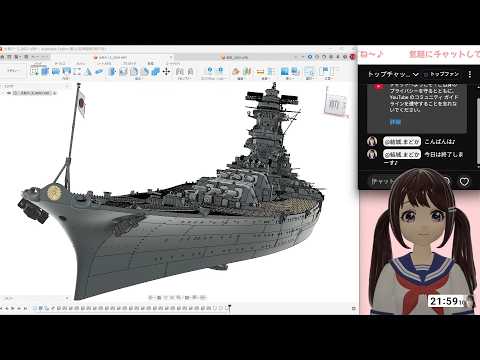
Modeling one of history's most iconic naval vessels is no small feat, especially when aiming for the precision required for a 1/350 scale replica. In this latest project session, the focus turns to the legendary Japanese Battleship Yamato, utilizing the powerful capabilities of Autodesk Fusion 360 to bring this massive steel giant into the digital age.
The Complexity of the Yamato’s Design
The Yamato remains a symbol of engineering ambition, and translating its complex lines into a 3D workspace requires a deep understanding of surface modeling. Unlike simpler mechanical parts, a battleship’s hull is a series of intricate, flowing curves designed for both hydrodynamic efficiency and heavy armor plating.
Using Autodesk Fusion 360, the modeling process involves meticulous sketching and the use of the "Loft" and "Spline" tools to ensure the hull's broadside is historically accurate. In this particular session, the primary focus is on the ship's side sections (the broadside), where the placement of armor belts and secondary battery ports must be calculated with millimeter precision.
Why Parametric Design Matters for Hobbyists
One of the greatest advantages of working within Autodesk Fusion 360 for a project like the 1/350 Yamato is parametric modeling. When working on a ship with hundreds of portholes, rivets, and anti-aircraft mounts, the ability to go back in time and adjust a single dimension without breaking the entire model is invaluable.
For creators who are used to traditional plastic model kits, such as those from Tamiya, moving into the digital CAD space offers a new level of freedom. You aren't just building a model; you are essentially "engineering" a digital twin. This approach allows for the eventual 3D printing of custom parts or even a full-scale digital museum piece.
Perfecting the Details
As the project progresses past the 400-stream mark, it becomes clear that the secret to a high-quality 3D model lies in the details. From the subtle flare of the bow to the specific tapering of the stern, every line tells a story. The current phase of the build focuses on the hull’s exterior textures and structural reinforcements, ensuring that the foundation of the ship is solid before moving on to the massive 46cm main turrets.
Whether you are a professional engineer or a historical enthusiast, the journey of recreating the Yamato is a masterclass in patience and precision. Stay tuned as we continue to push the boundaries of what is possible in digital naval architecture.


