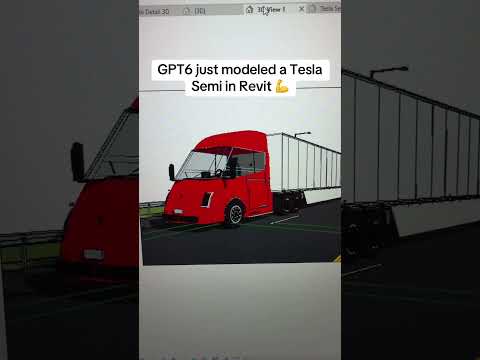
The AEC (Architecture, Engineering, and Construction) industry is standing on the precipice of a massive technological shift. For years, we have seen Artificial Intelligence generate stunning imagery and coherent text, but its application in the rigid, data-driven world of Building Information Modeling (BIM) has remained a "future" concept—until now. A groundbreaking demonstration has showcased GPT-6 modeling a highly detailed, native Tesla Semi directly within Autodesk Revit.
The Evolution of Native BIM Generation
One of the biggest hurdles in combining AI with architectural software has been the issue of "dumb" geometry. Most AI tools generate meshes that are visually impressive but functionally useless for construction documentation. This latest experiment changes the narrative by focusing on native BIM generation.
By leveraging the advanced logic of GPT-6, the AI doesn't just create a 3D shape; it understands the parameters, families, and constraints inherent to the Autodesk Revit environment. The result is a Tesla Semi model that isn't just a static block, but an intelligent object capable of existing seamlessly within a professional project ecosystem.
Why GPT-6 and Revit are a Game Changer
The complexity of a Tesla Semi—with its specific aerodynamic curves and industrial dimensions—serves as the perfect stress test for AI capabilities. Traditionally, modeling such a complex vehicle would require hours of manual work, focusing on intricate sweeps and family parameters.
By integrating AI directly into the workflow, designers can bypass the tedious manual placement of geometry. This synergy allows professionals to focus on high-level design decisions and spatial coordination while the AI handles the heavy lifting of complex component modeling. Using Autodesk Revit in tandem with an advanced LLM suggests a future where "prompt engineering" becomes just as vital as traditional drafting skills.
The Future of Scalable Design
As we move toward more integrated AI solutions, the role of the BIM manager and architect will inevitably evolve. The ability to generate complex, accurate vehicles or custom building components in seconds is no longer a gimmick; it is a glimpse into the future of scalable, automated design. We are moving away from clicking buttons and toward a world where we describe our vision, and the software—powered by AI—brings it to life with precision and speed.


