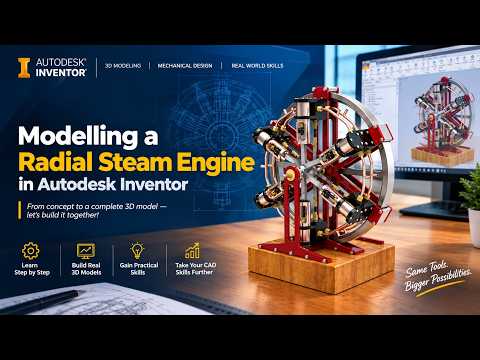
Welcome back to the Radial Steam Engine design series! In Part 43 of this multi-part project, we turn our attention to an essential component that ensures smooth mechanical operation: the trunk guide pin. Whether you are a student, hobbyist, or professional CAD designer, mastering precise mechanical modeling in Autodesk Inventor is key to building functional, real-world assemblies.
What is a Trunk Guide Pin?
In a radial steam engine, proper alignment and fluid motion are paramount. The trunk guide pin plays a vital role in maintaining the correct trajectory of moving parts within the guide assembly. By holding components securely in line, it minimizes mechanical play, reduces friction, and guarantees efficient power delivery throughout the engine's operation.
Key Modeling Steps in Autodesk Inventor
Creating this component requires precision and clean sketching techniques. Here is a breakdown of the standard workflow used in this lesson:
- Base Sketch Creation: Begin by establishing a 2D sketch on the chosen work plane. Define the central axis and precise cylindrical geometry using fully constrained parametric dimensions.
- Feature Generation: Convert your 2D sketch into a 3D solid using Autodesk Inventor's feature tools. For symmetrical cylindrical pins, a revolve feature is typically the fastest and cleanest approach.
- Detailing and Edges: Add precise chamfers and fillets to the pin's edges. These features facilitate smooth insertion during physical assembly and help prevent stress concentrations.
- Material and Physical Properties: Assign the appropriate mechanical material—such as hardened steel—to ensure accurate mass and density calculations across the full engine assembly.
Enhancing Your CAD Workflow
When working on complex mechanical projects, maintaining design intent is critical. Utilizing parametric constraints during the initial modeling stage allows you to make seamless dimension adjustments later if mechanical tolerances require fine-tuning.
By mastering these fundamental techniques in Autodesk Inventor, you establish a solid foundation for detailing intricate mechanical parts. Keep following along as we continue assembling every piece of this Radial Steam Engine project!


