000

Index Labels

Using ASP.NET Web API to Automate AutoCAD

.
Prior to AutoCAD ObjectARX .NET API, we used AutoCAD's COM API for both in-process (VBA or DLL that loads into VBA) and out-process (EXE) automation of AutoCAD. Then AutoCAD .NET API won most, if not all, AutoCAD programmers' favorite and AutoCAD COM API has been gradually fade into background. However, there are still times when people want to automate AutoCAD from external process/application, in which AutoCAD COM API still has significant advantage due to its fairly complete COM object model.

AutoCAD can also be automated from external application in pure .NET way. WCF as an mature .NET communication mechanism between processes/applications can be used to automate AutoCAD. There are a few samples/articles/post on this topic can be found on the Internet (unfortunately I did not keep their links:-().

I recently worked on a web application development project, in which ASP.NET Web API is used to expose business data as OData to be consumed by user side application (web application, mobile application or desktop). For those who want to know more about ASP.NET Web API, go to here for more details.

In spite its name "ASP.NET Web API" say "ASP.NET" and "Web", Web API is not just for web application. Like WCF, it is regarding communication between processes/applications, a much simplified in comparison to WCF. Its communication conduit is purely based on Http protocol, which, besides can be hosted in Windows' IIS server, can also be self hosted easily, thus effectively make its host's computing power available to outside world.

So, I explored a bit to see how I could use this technology to automate AutoCAD. To be honest, I am not a fan of automating AutoCAD from external application, even though I did develop a few applications doing this (mostly some kind of drawing batch processing operations), because AutoCAD is a very complicated desktop application and it is very often that an AutoCAD process needs user interaction to complete. So, the code I show here may not have much practical value to my real word AutoCAD development. It only shows a new way how AutoCAD can be automated from external application.

I used Visual Studio 2012/.NET 4.5 and AutoCAD 2014. The reason of using .NET 4.5 over .NET 4.0 is because the NuGet Manager only allows to get latest ASP.NET Web API Self-Host package, which requires .NET 4.5.

The Visual Studio solution and 3 projects in the solution are shown in pictures below:


1. Project AcadHttpDto

This project is a class library containing data classes used for communication between Http Web API server application (hosted inside AutoCAD) and Http client application. Dto in the project name stands for Data Transfer Object, which is commonly used in WCF with the class is decorated with attribute [DataContract] and its public member decorated with attribute [DataMember]. But in this development, since it is not WCF based, I just borrow the meaning of "DTO" for this project, implying the data classes here are used in similar way as DTO.

Currently the project only has 2 classes:

    1 namespace AcadHttpDto
    2 {
    3     public class AcadSysVar
    4     {
    5         public string Name { set; get; }
    6         public object Value { set; get; }
    7     }
    8 }

    1 namespace AcadHttpDto
    2 {
    3     public class CircleArgs
    4     {
    5         public double Radius { set; get; }
    6         public double X { set; get; }
    7         public double Y { set; get; }
    8         public double Z { set; get; }
    9     }
   10 }

2. Project AcadHttpServerHost

This project is an AutoCAD .NET DLL project that host Http Web API server. To host Web API server, the project needs to have references to a few libraries. I use NuGet Package Manager to add ASP.NET Web API Self Host package into this project:
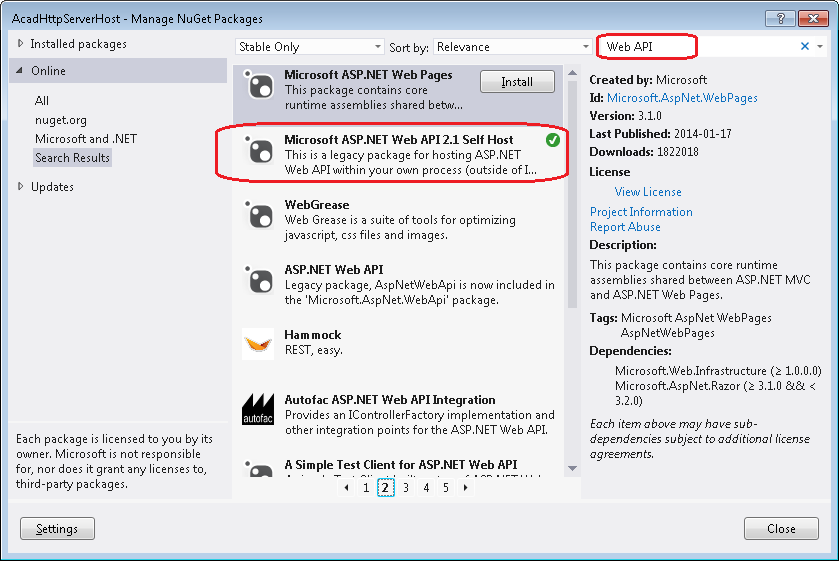

As aforementioned, the ASP.NET Web API 2.1 Self Host package requires .NET 4.5, therefore the entire solution of this development is based on .NET 4.5.

This project also references project AcadHttpDto.

Class HttpServerHostInitializer is the an IExtensionApplication class that starts an HttpSelfHostServer as soon as the DLL is loaded into AutoCAD:

    1 using System.Web.Http.SelfHost;
    2 using System.Web.Http;
    3 using Autodesk.AutoCAD.ApplicationServices;
    4 using Autodesk.AutoCAD.EditorInput;
    5 using Autodesk.AutoCAD.Runtime;
    6 
    7 [assembly: ExtensionApplication(
    8     typeof(AcadHttpServerHost.HttpServerHostInitializer))]
    9 
   10 namespace AcadHttpServerHost
   11 {
   12     public class HttpServerHostInitializer : IExtensionApplication
   13     {
   14         static HttpSelfHostServer _httpServer = null;
   15 
   16         #region IExtensionApplication Members
   17 
   18         public void Initialize()
   19         {
   20             Document dwg = Application.DocumentManager.MdiActiveDocument;
   21             Editor ed = dwg.Editor;
   22 
   23             try
   24             {
   25                 ed.WriteMessage("\nInitializing HTTP server hosting...");
   26 
   27                 _httpServer =
   28                     CreateHttpSelfHostServer("http://localhost:54321");
   29                 _httpServer.OpenAsync().Wait();
   30 
   31                 ed.WriteMessage("completed.");
   32                 Autodesk.AutoCAD.Internal.Utils.PostCommandPrompt();
   33             }
   34             catch (System.Exception ex)
   35             {
   36                 ed.WriteMessage("failed:\n");
   37                 ed.WriteMessage(ex.Message);
   38                 Autodesk.AutoCAD.Internal.Utils.PostCommandPrompt();
   39             }
   40 
   41 
   42         }
   43 
   44         public void Terminate()
   45         {
   46             if (_httpServer != null)
   47             {
   48                 _httpServer.Dispose();
   49             }
   50         }
   51 
   52         #endregion
   53 
   54         #region private methods
   55 
   56         private HttpSelfHostServer CreateHttpSelfHostServer(string baseUrl)
   57         {
   58             HttpSelfHostConfiguration config = ConfigurateHost(baseUrl);
   59             HttpSelfHostServer server = new HttpSelfHostServer(config);
   60             return server;
   61         }
   62 
   63         private HttpSelfHostConfiguration ConfigurateHost(string baseUrl)
   64         {
   65             HttpSelfHostConfiguration config =
   66                 new HttpSelfHostConfiguration(baseUrl);
   67 
   68             config.Routes.MapHttpRoute(
   69                 name: "Default Api",
   70                 routeTemplate: "api/{controller}/{id}",
   71                 defaults: new { id = RouteParameter.Optional }
   72                 );
   73 
   74             return config;
   75         }
   76 
   77         #endregion
   78     }
   79 }

As we can see, self-hosting Web API server can be easily done with just a few lines of code. Once a few Web API controllers are added into the project, the self-hosted server would be open through Http channel for external applications to communicate to the server and AutoCAD, the host.

With self-host server ready to run, it is time to add a few Web API Controllers that accept Http requests (GET/POST/PUT/DELETE...). I first created a base ApiController class AcadActionController:

    1 using System.Text;
    2 using System.Web.Http;
    3 
    4 namespace AcadHttpServerHost
    5 {
    6     public class AcadActionController : ApiController
    7     {
    8         private static StringBuilder _msg = new StringBuilder();
    9         public static StringBuilder ActionMessage
   10         {
   11             get { return _msg; }
   12         }
   13     }   
   14 }

Then I added 2 classes that does the actual work: accepting Http request, doing something (in AutoCAD) based on the request and sending response back to the client. For the purpose of the simple exploration, I created one controller that get and set AutoCAD's system variables, and the other one that makes AutoCAD draw something in current AutoCAD working database.

Here is class SysVariableController:

    1 using System.Net;
    2 using System.Net.Http;
    3 using System.Web.Http;
    4 using AcadHttpDto;
    5 using Autodesk.AutoCAD.ApplicationServices;
    6 using Autodesk.AutoCAD.DatabaseServices;
    7 
    8 namespace AcadHttpServerHost
    9 {
   10     public class SysVariableController : AcadActionController
   11     {
   12         public string Get(string varName)
   13         {
   14             try
   15             {
   16                 object varValue = Application.GetSystemVariable(varName);
   17                 return varValue.ToString();
   18             }
   19             catch
   20             {
   21                 return "Invalid SYSTEM VARIABLE name: \"" + varName + "\"";
   22             }
   23         }
   24 
   25         public string Get()
   26         {
   27             return "Please supply SYSTEM VARIABLE name!";
   28         }
   29 
   30         public HttpResponseMessage Put([FromBody]AcadSysVar sysVar)
   31         {
   32             ActionMessage.Length = 0;
   33             HttpStatusCode code = HttpStatusCode.Accepted;
   34 
   35             if (sysVar == null)
   36             {
   37                 code = HttpStatusCode.ExpectationFailed;
   38                 ActionMessage.Append("SysVar argument is not supplied.");
   39             }
   40             else
   41             {
   42                 if (!UpdateSystemVariable(sysVar))
   43                 {
   44                     code = HttpStatusCode.ExpectationFailed;
   45                 }
   46             }
   47 
   48             if (code != HttpStatusCode.Accepted)
   49                 return Request.CreateErrorResponse(
   50                     code, ActionMessage.ToString());
   51             else
   52                 return Request.CreateResponse<string>(
   53                     code, ActionMessage.ToString());
   54         }
   55 
   56         private bool UpdateSystemVariable(AcadSysVar sysVar)
   57         {
   58             try
   59             {
   60                 Database db = HostApplicationServices.WorkingDatabase;
   61                 Document doc = Application.DocumentManager.GetDocument(db);
   62                 using (DocumentLock l = doc.LockDocument())
   63                 {
   64                     Application.SetSystemVariable(sysVar.Name, sysVar.Value);
   65                 }
   66                 ActionMessage.Append(
   67                     "System variable \"" + sysVar.Name +
   68                     "\" is updated successfully.");
   69                 return true;
   70             }
   71             catch (System.Exception ex)
   72             {
   73                 ActionMessage.Append(
   74                     "Setting system variable \"" + sysVar.Name +
   75                     "\" failed:\n" + ex.Message);
   76                 return false;
   77             }
   78         }
   79     }
   80 }

Here is class DrawController:

    1 using System.Net.Http;
    2 using System.Net;
    3 using Autodesk.AutoCAD.ApplicationServices;
    4 using Autodesk.AutoCAD.DatabaseServices;
    5 using Autodesk.AutoCAD.Geometry;
    6 using AcadHttpDto;
    7 
    8 namespace AcadHttpServerHost
    9 {
   10     public class DrawController : AcadActionController
   11     {
   12         public HttpResponseMessage Put(CircleArgs circleArgs)
   13         {
   14             ActionMessage.Length = 0;
   15             HttpStatusCode code = HttpStatusCode.Created;
   16 
   17             if (circleArgs == null)
   18             {
   19                 code = HttpStatusCode.ExpectationFailed;
   20                 ActionMessage.Append("Circleargs argument is not supplied.");
   21             }
   22             else
   23             { 
   24                 if (!DrawCircle(circleArgs))
   25                 {
   26                     code = HttpStatusCode.ExpectationFailed;
   27                 }
   28             }
   29 
   30             if (code != HttpStatusCode.Created)
   31                 return Request.CreateErrorResponse(
   32                     code, ActionMessage.ToString());
   33             else
   34                 return Request.CreateResponse<string>(
   35                     code, ActionMessage.ToString());
   36         }
   37 
   38         #region private methods
   39 
   40         private bool DrawCircle(CircleArgs args)
   41         {          
   42             Database db = HostApplicationServices.WorkingDatabase;
   43             Document doc = Application.DocumentManager.GetDocument(db);
   44 
   45             using (DocumentLock l = doc.LockDocument())
   46             {
   47                 try
   48                 {
   49                     using (Transaction tran =
   50                         db.TransactionManager.StartTransaction())
   51                     {
   52                         BlockTableRecord model = tran.GetObject(
   53                             SymbolUtilityServices.GetBlockModelSpaceId(db),
   54                             OpenMode.ForWrite)
   55                             as BlockTableRecord;
   56 
   57                         Circle c = new Circle();
   58                         c.Center = new Point3d(args.X, args.Y, args.Z);
   59                         c.Radius = args.Radius;
   60                         c.SetDatabaseDefaults(db);
   61 
   62                         model.AppendEntity(c);
   63                         tran.AddNewlyCreatedDBObject(c, true);
   64 
   65                         tran.Commit();
   66                     }
   67 
   68                     ActionMessage.Append(
   69                         "Cicle has been added into drawing successfully.");
   70 
   71                     return true;
   72                 }
   73                 catch (System.Exception ex)
   74                 {
   75                     string error = ex.Message;
   76                     ActionMessage.Append(
   77                         "Drawing circle failed:\n" + ex.Message);
   78                     return false;
   79                 }
   80             }
   81         }
   82 
   83         #endregion
   84     }
   85 }

If looking into the code carefully, one would notice that I get a reference to current drawing document via HostApplicationServices.WorkingDatabase->Application.DocumentManager.GetDocument(Database)

Due to the way the Http self-host server runs, the MdiActiveDocuement is not available. I did not bother, or have time, to dig out the reason, as long as my exploration worked the way I did it.

Also, by following Http command tradition, the Put() method is meant for updating, thus the DrawController uses Put() to take client's request to draw something in AutoCAD. If I want to drawing something else rather than circle, I would create another Dto data class in AcadHttpDto project (say, LineArgs, which has data for a line's 2 end points) and add an overloaded Put() method that has different argument (LineArgs for drawing a line).

Now with just the 2 projects (AcadHttpDto and AcadHttpServerHost) being built, AutoCAD is ready to host the Http Web API inside and accept external requests and acts accordingly.

For any programmer who is familiar to web programming, Fiddler is a very well-known, a must-have free tool. I used Fiddler for testing the above self-host Web API code in AutoCAD before I actually wrote a Http client application.

This video clip shows using Fiddler to get/set AutoCAD system variable.
This video clip shows using Fiddler to have AutoCAD draw a circle.

After verifying the Web API server hosted in AutoCAD works as expected with Fiddler, I then continued the exploration to start the third project, a WinForm application with its UI looks like:


3. Project AcadHttpClient

This project also need to set reference to Web API client library. Again, I used NuGet Package Manager to get this done:


Of course this project also references project AcadHttpDto.

Here is the code behind the UI form (Form1):

    1 using System;
    2 using System.Net.Http;
    3 using System.Windows.Forms;
    4 using AcadHttpDto;
    5 
    6 namespace AcadHttpClient
    7 {
    8     public partial class Form1 : Form
    9     {
   10         HttpClient _client = null;
   11 
   12         public Form1()
   13         {
   14             InitializeComponent();
   15         }
   16 
   17         #region private methods
   18 
   19         private void ValidateVariable()
   20         {
   21             btnChangeVariable.Enabled = txtVariable.Text.Trim().Length > 0;
   22         }
   23 
   24         private void ValidateDraw()
   25         {
   26             if (txtRadius.Text.Trim().Length > 0 &&
   27                 txtX.Text.Trim().Length > 0 &&
   28                 txtY.Text.Trim().Length > 0 &&
   29                 txtX.Text.Trim().Length > 0)
   30             {
   31                 double d;
   32                 try
   33                 {
   34                     d = double.Parse(txtRadius.Text);
   35                     d = double.Parse(txtX.Text);
   36                     d = double.Parse(txtY.Text);
   37                     d = double.Parse(txtZ.Text);
   38                     btnDrawCircle.Enabled = true;
   39                 }
   40                 catch
   41                 {
   42                     btnDrawCircle.Enabled = false;
   43                 }
   44             }
   45             else
   46             {
   47                 btnDrawCircle.Enabled = false;
   48             }
   49         }
   50 
   51         private void GetSystemVariable()
   52         {
   53             string sysVarName=cboVariable.Text;
   54             HttpResponseMessage resMsg = _client.GetAsync(
   55                 "api/SysVariable/?varName=" + sysVarName).Result;
   56             resMsg.EnsureSuccessStatusCode();
   57 
   58             var txt = resMsg.Content.ReadAsAsync<string>().Result;
   59             txtVariable.Text = txt;
   60         }
   61 
   62         private void SetSystemVariable()
   63         {
   64             AcadSysVar sysVar = new AcadSysVar();
   65             sysVar.Name = cboVariable.Text;
   66             if (cboVariable.Text.ToUpper() == "DIMSCALE")
   67                 sysVar.Value = Convert.ToDouble(txtVariable.Text);
   68             else
   69                 sysVar.Value = txtVariable.Text.Trim();
   70 
   71             HttpResponseMessage resMsg =
   72                 _client.PutAsJsonAsync("api/SysVariable", sysVar).Result;
   73 
   74             var txt = resMsg.Content.ReadAsAsync<string>().Result;
   75             MessageBox.Show(txt);
   76 
   77         }
   78 
   79         private void DrawCircle()
   80         {
   81             double r, x, y, z;
   82             if (!GetCircleInputs(out r, out x, out y, out z))
   83             {
   84                 MessageBox.Show("Invalid circle parameter input!");
   85                 return;
   86             }
   87 
   88             CircleArgs args = new CircleArgs()
   89             {
   90                 Radius = r,
   91                 X = x,
   92                 Y = y,
   93                 Z = z
   94             };
   95 
   96             HttpResponseMessage resMsg =
   97                 _client.PutAsJsonAsync("api/Draw", args).Result;
   98 
   99             var txt = resMsg.Content.ReadAsAsync<string>().Result;
  100             MessageBox.Show(txt);
  101         }
  102 
  103         private bool GetCircleInputs(
  104             out double r, out double x, out double y, out double z)
  105         {
  106             r = 0.0;
  107             x = 0.0;
  108             y = 0.0;
  109             z = 0.0;
  110 
  111             try
  112             {
  113                 r = double.Parse(txtRadius.Text);
  114                 x = double.Parse(txtX.Text);
  115                 y = double.Parse(txtY.Text);
  116                 z = double.Parse(txtZ.Text);
  117             }
  118             catch
  119             {
  120                 return false;
  121             }
  122 
  123             return true;
  124         }
  125 
  126 
  127         #endregion
  128 
  129 
  130         private void Form1_Load(object sender, EventArgs e)
  131         {
  132             cboVariable.SelectedIndex = 0;
  133             ValidateDraw();
  134             ValidateVariable();
  135 
  136             _client = new HttpClient();
  137             _client.BaseAddress = new Uri("http://localhost:54321");
  138             _client.DefaultRequestHeaders.Accept.Add(
  139                 new System.Net.Http.Headers.MediaTypeWithQualityHeaderValue(
  140                     "application/json"));
  141         }
  142 
  143         private void btnExit_Click(object sender, EventArgs e)
  144         {
  145             if (_client != null)
  146             {
  147                 _client.Dispose();
  148             }
  149 
  150             this.Close();
  151         }
  152 
  153         private void txtVariable_TextChanged(object sender, EventArgs e)
  154         {
  155             ValidateVariable();
  156         }
  157 
  158         private void txtRadius_TextChanged(object sender, EventArgs e)
  159         {
  160             ValidateDraw();
  161         }
  162 
  163         private void txtX_TextChanged(object sender, EventArgs e)
  164         {
  165             ValidateDraw();
  166         }
  167 
  168         private void txtY_TextChanged(object sender, EventArgs e)
  169         {
  170             ValidateDraw();
  171         }
  172 
  173         private void txtZ_TextChanged(object sender, EventArgs e)
  174         {
  175             ValidateDraw();
  176         }
  177 
  178         private void cboVariable_SelectedIndexChanged(object sender, EventArgs e)
  179         {
  180             if (cboVariable.SelectedIndex == 0)
  181             {
  182                 txtVariable.Text = "";
  183                 txtVariable.Enabled = false;
  184             }
  185             else
  186             {
  187                 GetSystemVariable();
  188                 txtVariable.Enabled = true;
  189             }
  190         }
  191 
  192         private void btnChangeVariable_Click(object sender, EventArgs e)
  193         {
  194             SetSystemVariable();
  195         }
  196 
  197         private void btnDrawCircle_Click(object sender, EventArgs e)
  198         {
  199             DrawCircle();
  200         }
  201     }
  202 }

Here is the video clip showing how the Windows EXE application interacts with AutoCAD through ASP.NET Web API server hosed inside AutoCAD.

Download the source code of the Visual Studio 2012 solution here.


Blog Archive

Labels

.NET Programming 2D Drafting 3D Animation 3D Art 3D Artist 3D design 3D effects 3D Engineering 3D Materials 3D Modeling 3D models 3D presentation 3D Printing 3D rendering 3D scanning 3D scene 3D simulation 3D Sketch Inventor 3D Texturing 3D visualization 3D Web App 3ds Max 4D Simulation ACC Adaptive Clearing adaptive components Add-in Development Additive Manufacturing Advanced CAD features Advanced Modeling AEC Technology AEC Tools affordable Autodesk tools AI AI animation AI Assistance AI collaboration AI Design AI Design Tools AI Experts AI for Revit AI Guide AI in CAD AI in CNC AI in design AI in Manufacturing AI in Revit AI insights AI lighting AI rigging AI Tips AI Tools AI troubleshooting AI workflow AI-assisted AI-assisted rendering AI-enhanced Animation animation pipeline animation tips Animation workflow annotation AR architectural design architectural modeling architectural preservation architectural visualization Architecture architecture design Architecture Engineering Architecture Firm Architecture Productivity architecture software architecture technology Architecture Workflow Arnold Renderer Arnold Shader Artificial Intelligence As-Built Model Asset Management augmented reality AutoCAD AutoCAD advice AutoCAD API AutoCAD Basics AutoCAD Beginner AutoCAD Beginners AutoCAD Civil 3D AutoCAD Civil3D AutoCAD commands AutoCAD efficiency AutoCAD Expert Advice AutoCAD features AutoCAD File Management AutoCAD Layer AutoCAD Layers AutoCAD learning AutoCAD print settings AutoCAD productivity AutoCAD Teaching AutoCAD Techniques AutoCAD tips AutoCAD tools AutoCAD training. AutoCAD tricks AutoCAD Tutorial AutoCAD workflow AutoCAD Xref Autodesk Autodesk 2025 Autodesk 2026 Autodesk 3ds Max Autodesk AI Autodesk AI Tools Autodesk Alias Autodesk AutoCAD Autodesk BIM Autodesk BIM 360 Autodesk Certification Autodesk Civil 3D Autodesk Cloud Autodesk community forums Autodesk Construction Cloud Autodesk Docs Autodesk Dynamo Autodesk features Autodesk for Education Autodesk Forge Autodesk FormIt Autodesk Fusion Autodesk Fusion 360 Autodesk help Autodesk InfraWorks Autodesk Inventor Autodesk Inventor Frame Generator Autodesk Inventor iLogic Autodesk Knowledge Network Autodesk License Autodesk Maya Autodesk mistakes Autodesk Navisworks Autodesk news Autodesk plugins Autodesk productivity Autodesk Recap Autodesk resources Autodesk Revit Autodesk Software Autodesk support ecosystem Autodesk Takeoff Autodesk Tips Autodesk training Autodesk tutorials Autodesk update Autodesk Upgrade Autodesk Vault Autodesk Video Autodesk Viewer Automated Design Automation Automation Tutorial automotive design automotive visualization Backup Basic Commands Basics Batch Plot Beginner Beginner Tips beginner tutorial beginners guide Big Data BIM BIM 360 BIM Challenges BIM collaboration BIM Compliance BIM Coordination BIM Data BIM Design BIM Efficiency BIM for Infrastructure BIM Implementation BIM Library BIM Management BIM modeling BIM software BIM Standards BIM technology BIM tools BIM Trends BIM workflow Block Editor Block Management Block Organization Building Design Software Building Maintenance building modeling Building Systems Building Technology ByLayer CAD CAD API CAD assembly CAD Automation CAD Blocks CAD CAM CAD commands CAD comparison CAD Customization CAD Data Management CAD Design CAD errors CAD Evolution CAD File Size Reduction CAD Integration CAD Learning CAD line thickness CAD management CAD Migration CAD mistakes CAD modeling CAD Optimization CAD plugins CAD Productivity CAD Rendering CAD Security CAD Skills CAD software CAD software 2026 CAD software training CAD standards CAD technology CAD Tips CAD Tools CAD tricks CAD Tutorial CAD workflow CAM car design software Case Study CEO Guide CGI design Character Rig cinematic lighting Civil 3D Civil 3D hidden gems Civil 3D productivity Civil 3D tips civil design software civil engineering Civil engineering software Clash Detection Class-A surfacing clean CAD file cleaning command client engagement Cloud CAD Cloud Collaboration Cloud design platform Cloud Engineering Cloud Management Cloud Storage Cloud-First CNC CNC machining collaboration command abbreviations Complex Renovation concept car conceptual workflow Connected Design construction Construction Analytics Construction Automation Construction BIM Construction Cloud Construction Planning Construction Scheduling Construction Technology contractor tools Contractor Workflow Contraints corridor design Cost Effective Design cost estimation Create resizable blocks Creative Teams CTB STB Custom visual styles Cutting Parameters Cybersecurity Data Backup data management Data Protection Data Reference Data Security Data Shortcut Design Automation Design Career Design Collaboration Design Comparison Design Coordination design efficiency Design Engineering Design Hacks Design Innovation design optimization Design Options design productivity design review Design Rules design software design software tips Design Technology design tips Design Tools Design Workflow design-to-construction Designer Designer Tools Digital Art Digital Assets Digital Construction Digital Construction Technology Digital Content Digital Design Digital engineering digital fabrication Digital Manufacturing digital marketing digital takeoff Digital Thread Digital Tools Digital Transformation Digital Twin Digital Twins digital workflow dimension dimensioning Disaster Recovery drafting Drafting Efficiency Drafting Shortcuts Drafting Standards Drafting Tips Drawing Drawing Automation drawing tips Dref Dynamic Block Dynamic Block AutoCAD Dynamic Blocks Dynamic doors Dynamic windows Dynamo Dynamo automation early stage design eco design editing commands Electrical Systems Emerging Features Energy Analysis energy efficiency Engineering Engineering Automation engineering data Engineering Design Engineering Innovation Engineering Productivity Engineering Skills engineering software Engineering Technology engineering tools Engineering Tools 2025 Engineering Workflow Excel Export Workflow Express Tools External Reference facial animation Facial Rigging Facility Management Families Fast Structural Design Field Documentation File Optimization File Recovery Flame flange tips flat pattern Forge Development Forge Viewer FreeCAD Fusion 360 Fusion 360 API Fusion 360 tutorial Future of Design Future Skills Game Development Gamification Generative Design Geospatial Data GIS Global design teams global illumination grading optimization green building Green Technology Grips Handoff HDRI health check Healthcare Facilities heavy CAD file Heavy CAD Files heritage building conservation hidden commands Hospital Design HVAC HVAC Design Tools HVAC Engineering Hydraulic Modeling IK/FK iLogic Import Workflow Industry 4.0 Infrastructure infrastructure design Infrastructure Monitoring Infrastructure Planning Infrastructure Technology InfraWorks innovation Insight intelligent modeling Interactive Design interactive presentation Interior Design Inventor Inventor API Inventor Drawing Template Inventor Frame Generator Inventor Graphics Issues Inventor IDW Inventor Tips Inventor Tutorial IoT ISO 19650 joints Keyboard Shortcuts keyframe animation Keyframe generation Landscape Design Large Projects Laser Scan Layer Management Layer Organization Learn AutoCAD Legacy CAD Licensing light techniques Lighting and shading Lighting Techniques Linked Models Machine Learning Machine Learning in CAD Machine Optimization Machining Efficiency maintenance command Management manufacturing Manufacturing Innovation Manufacturing Technology Mapping Technology marketing visuals Material Creation Maya Maya character animation Maya lighting Maya Shader Maya Tips Maya tutorial measurement Mechanical Design Mechanical Engineering Media & Entertainment MEP Modeling Mesh-to-BIM Metal Structure modal analysis Model Management Model Optimization Modeling Secrets Modular Housing Motion capture motion graphics motion simulation MotionBuilder Multi Office Workflow Multi-User Environment multileader Navisworks Navisworks Best Practices Net Zero Design ObjectARX .NET API Open Source CAD Organization OVERKILL OVERKILL AutoCAD Page Setup Palette Parametric Components parametric design parametric family Parametric Modeling particle effects particle systems PDF PDM system Personal Brand Phasing PlanGrid Plot Settings Plot Style Plot Style AutoCAD Plotting Plugin Tutorial Plumbing Design point cloud Portfolio Post Construction Post-Processing Practice Drawing preconstruction workflow predictive analysis predictive animation Predictive Maintenance Predictive rigging Prefabrication Presentation-ready visuals Printing Printing Quality Procedural animation procedural motion Procedural Rig Procedural Textures Product Design Product Development product lifecycle product rendering Productivity productivity tools Professional 3D design Professional CAD Professional Drawings professional printing Professional Tips Project Documentation project efficiency project management Project Management Tools Project Visualization PTC Creo PURGE PURGE AutoCAD Rail Transit Rapid Prototyping realistic rendering ReCap Redshift Shader reduce CAD file size Render Render Passes Render Quality Render Settings Rendering rendering engine Rendering Engines Rendering Optimization rendering software Rendering Tips Rendering Workflow RenderMan Renewable Energy Renovation Project Renovation Workflow Reports Resizable Block restoration workflow Revit Revit add-ins Revit API Revit automation Revit Best Practices Revit Collaboration Revit Documentation Revit Family Revit integration Revit MEP Revit Performance Revit Phasing Revit Plugins Revit Scripting Revit skills Revit Standards Revit Template Revit Tips Revit tutorial Revit Workflow Ribbon Rigging robotics ROI Scale Autodesk Schedules screen Sculpting Secure Collaboration Sensor Data Shader Networks Sheet Metal Design Sheet Metal Tricks Sheet Set Manager shortcut keys Shortcuts Siemens NX Simulation simulation tools Sketch Sketching Tricks Small Firms Smart Architecture Smart Block Smart Building Design Smart City Smart Design Smart Engineering Smart Factory Smart Infrastructur Software Compliance software ecosystem Software Management Software Trends software troubleshooting Software Update Solar Energy Solar Panels SolidWorks Startup Design static stress Steel Structure Design Structural Optimization subscription model Subscription Value Surface Modeling sustainability sustainable design Sustainable Manufacturing system performance T-Spline team training guide Technical Drawing technical support Template Setup text style Texture Mapping Texturing thermal analysis Time Management time saving tools Title Blocks toolbar Toolpath Optimization Toolpaths Topography Troubleshooting Tutorial Tutorials urban planning User Interface (UI) UV Mapping UV Unwrap V-Ray Vault Best Practices Vault Lifecycle Vault Mistakes Vector Plotting vehicle modeling VFX Viewport configuration Virtual Environments virtual reality visual effects visualization workflow VR VR Tools VRED Water Infrastructure Water Management Weight Painting What’s New in Autodesk Wind Energy Wind Turbines Workbook workflow Workflow Automation workflow efficiency Workflow Optimization Workflow Tips Worksets Worksharing Workspace XLS Xref Xrefs เขียนแบบ